
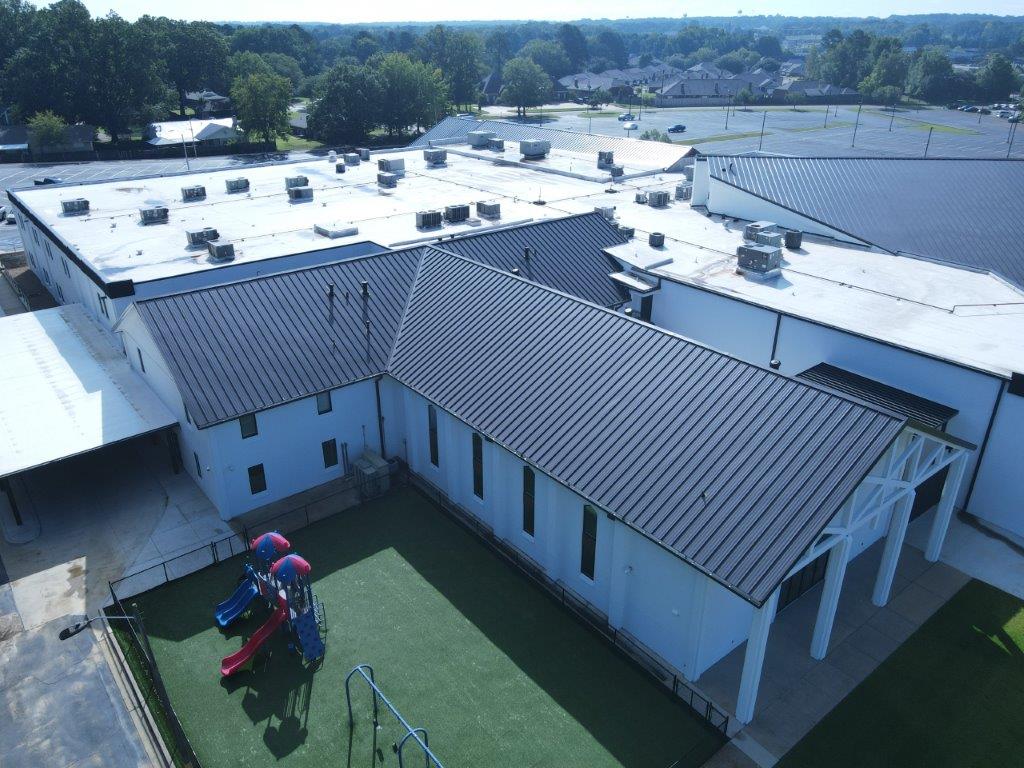
Church and Religious Building Roofing work starts with verified roof conditions, clear repair limits, and a practical decision path for the building owner.
Church and Religious Building Roofing roof scope
Second Baptist Church of Little Rock, one of the largest and most historically rooted congregations in the Arkansas River Valley, sits beneath a clear-span roof system that has sheltered its community through decades of Arkansas storms, including the kind of straight-line wind events and spring hail that make commercial roofing on religious buildings in this region a genuinely technical undertaking. When that roof approaches the end of its service life, the stakes for getting the replacement right are as high as any institutional project in Pulaski County.
Commercial church roofing in Little Rock demands a contractor who understands Arkansas's storm climate. The state sits in a corridor of significant severe weather activity, large hail from April through June, strong thunderstorm winds, and occasional tornado events. Every roofing assembly we specify for Little Rock congregations is selected with impact resistance and wind uplift in mind. On membrane systems, we use mechanically fastened or fully adhered installations with tested pull-out values that meet or exceed the local wind design pressure requirements.
Clear-span sanctuary roofs present a structural loading challenge that distinguishes church work from ordinary commercial projects. The absence of interior columns means all dead load, live load, and any wind or rain loading on the roof surface travels to the building's perimeter framing or steel arches. We review structural drawings before specifying roofing assemblies, ensuring that insulation thickness, membrane weight, and any ballast component remain within the original design loading envelope.
Architectural character matters deeply to Arkansas congregations. Many Little Rock churches feature brick or stone facades with decorative parapets, cornices, and ornamental metalwork at the roofline. These elements require custom-formed copper or galvanized steel flashing, properly counter-flashed and caulked with polyurethane sealants compatible with the adjacent masonry. We mock up flashing details before full installation so the building committee can review workmanship expectations before crews move across the entire roof.
Church building committees in Little Rock operate on a consensus decision model that can involve properties trustees, deacons, associate pastors, and in some congregations a full member vote on expenditures above a certain threshold. We have learned to provide layered proposal documentation, an executive summary for leadership, a full technical specification for the properties committee, and a simplified FAQ sheet for congregational meetings. Having the right document for the right audience keeps large roofing projects moving through approval channels without stalling.
Capital campaigns are a common funding mechanism for large roof replacements at established Little Rock congregations. When a church is raising $1 million or more for facilities improvements, the roofing contractor is often asked to provide specification documents, long-term cost projections, and warranty summaries suitable for inclusion in campaign materials. We routinely produce these deliverables and make ourselves available to present at building committee meetings or, when appropriate, to congregation leadership gatherings.
Summer scheduling works well for Little Rock roofing projects because the congregation's weekday footprint shrinks significantly from June through August. Vacation Bible School schedules and Sunday service times still need to be coordinated, but the absence of Wednesday evening programming, choir rehearsals, and youth activities most weekday evenings gives crews the uninterrupted access they need. We build the congregation's calendar into our project schedule at the kickoff meeting and revisit it weekly.
Planning Questions
What decides the right church and religious building roofing path?
The roof assembly, leak history, drainage, access, rooftop equipment, and operating risk below the roof all shape the recommendation.
Can work be phased around occupied spaces?
Yes. The scope should identify tenant-sensitive areas, daily dry-in expectations, access routes, and weather limits before production starts.
What documentation should ownership expect?
Photo records, repair notes, roof-area observations, product information when applicable, and a clear summary of remaining roof risks.