
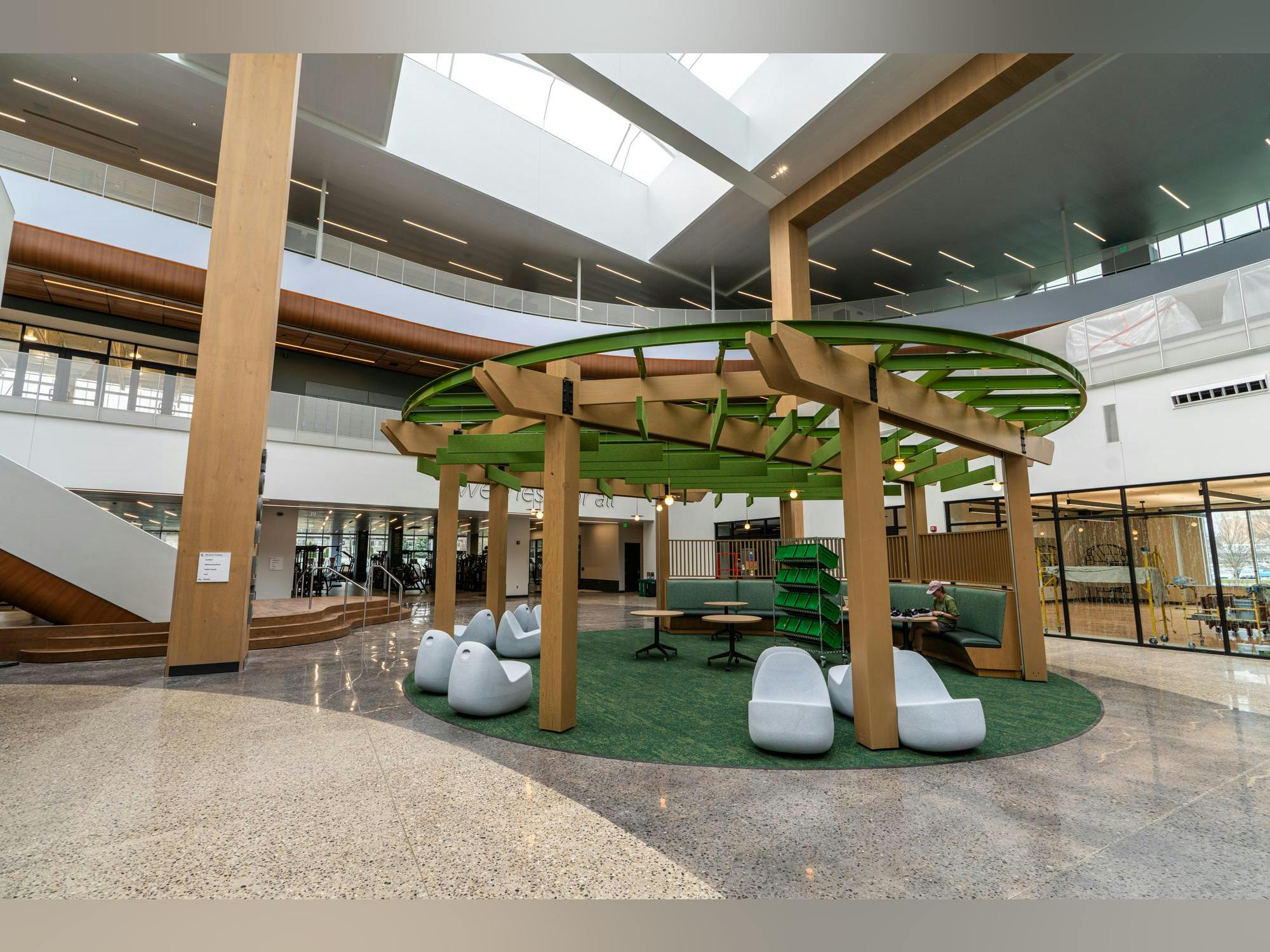
Fitness Center & Gym Roofing work starts with verified roof conditions, clear repair limits, and a practical decision path for the building owner.
Fitness Center & Gym Roofing roof scope
A gym roof has two problems most commercial roofs do not: a wide-open span overhead and a building full of people generating heat and moisture underneath. Walk into almost any fitness center in Little Rock, the big-box clubs along the Chenal corridor and out by the Promenade, the locations anchoring strip centers off Rodney Parham and University Avenue, the boutique studios filling space in the River Market and Argenta, and you are standing under a roof deck that spans a long way with no columns and carries a heavy rack of rooftop equipment fighting to keep the air breathable. Both of those realities have to drive the roofing scope, or the roof fails early from a direction the owner never sees coming.
The moisture is the part people underestimate. Showers, locker rooms, steam rooms, hot tubs, and pool enclosures push interior humidity high, and that water vapor wants to migrate up into the roof assembly from below no matter how tight the membrane is on top. If the vapor control layer is positioned wrong for our climate, that vapor condenses inside the insulation, soaks the R-value out of it, and rots the assembly from the inside while the surface still looks fine. A correct fitness center roof in Little Rock addresses interior vapor drive as part of the assembly design from the start, not as a warranty claim later.
The open training floor that makes a gym usable also makes the roof structure unusual. A clear-span steel deck running 40, 60, or 80 feet between supports deflects and takes wind uplift differently than the short bays over an office, and the fastening pattern has to be calculated for the actual span and deck gauge rather than pulled from a standard detail. We evaluate the deck and span before we specify attachment, because under-fastening a long-span gym roof is how you end up with membrane billowing loose in the first strong Arkansas storm line that comes through.
High occupancy means high ventilation demand. A packed cardio floor, group-exercise rooms, locker rooms, and any pool enclosure each carry dedicated air handling, so the penetration count on a fitness center roof typically runs two to three times what a same-size retail or office building would have. Every one of those curbs, exhaust fans, and supply units is a potential leak, and in a humid gym environment the standard curb wrap is not enough. We document every penetration, curb height, and clearance before pricing, raise or rebuild undersized curbs to meet warranty height, and flash each one for the conditions these buildings actually create rather than the conditions a generic detail assumes.
Fitness centers in Little Rock open before dawn and close near midnight, and plenty run 24 hours, every day of the year. There is no overnight window where the building sits quiet, so the schedule is part of the scope and not a change order. We set crew start times and noise limits around occupied locker rooms and early classes, coordinate around pool-chemical deliveries and the HVAC maintenance that keeps an indoor pool in compliance with state health standards, and confirm watertight dry-in daily so the manager knows the roof is protected before the next operating cycle starts. Members should never know we are up there.
For clubs with pool enclosures, steam, or heavy wet areas we lean toward a 60-mil TPO or PVC membrane fully adhered. An adhered system removes the field of fastener penetrations a mechanically attached roof relies on and gives a more vapor-resistant assembly at the membrane plane, which matters when there is constant humidity pressing up from below. For dry gyms without pool areas, 60-mil TPO mechanically attached is appropriate and more economical, with the attachment still designed to the real span. In every case the vapor retarder is positioned for Little Rock's climate zone and the building's actual interior conditions.
The national operators, the regional clubs, and the independent studios all run different approval and documentation processes, and we work inside whichever one applies. Whether you are a corporate facilities manager with a vendor program or an owner managing a single location, closeout looks the same: permit and inspection records, manufacturer warranty registration, a roof zone diagram with the full penetration inventory, and drain and flashing inspection documentation for your asset file, formatted to match a corporate facilities system when there is one.
Planning Questions
What decides the right fitness center & gym roofing path?
The roof assembly, leak history, drainage, access, rooftop equipment, and operating risk below the roof all shape the recommendation.
Can work be phased around occupied spaces?
Yes. The scope should identify tenant-sensitive areas, daily dry-in expectations, access routes, and weather limits before production starts.
What documentation should ownership expect?
Photo records, repair notes, roof-area observations, product information when applicable, and a clear summary of remaining roof risks.