
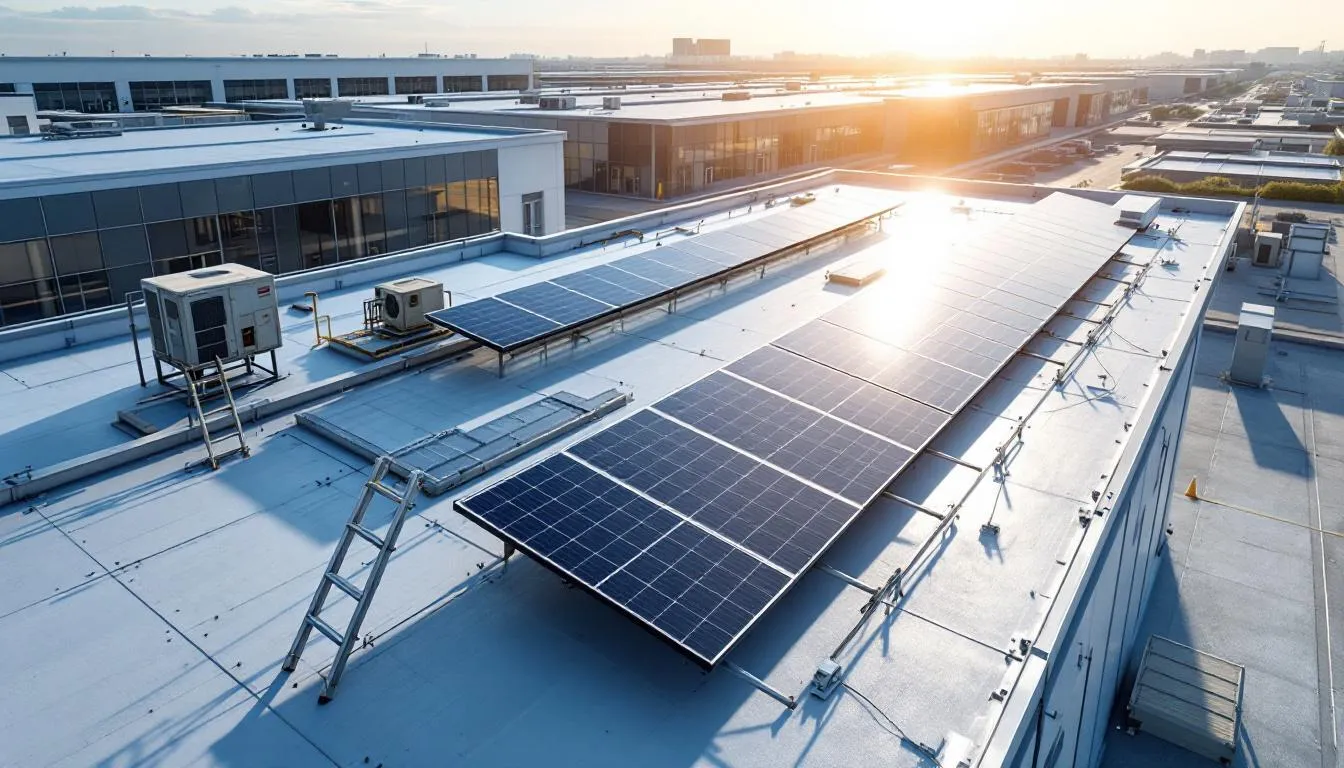
Industrial Flex Space Roofing work starts with verified roof conditions, clear repair limits, and a practical decision path for the building owner.
Industrial Flex Space Roofing roof scope
Industrial flex is the chameleon of the commercial inventory. A single low-slope building might hold a light assembly shop in one bay, a distribution operation in the next, an electrical contractor's warehouse beyond that, and a small office-lab suite at the end, and those uses turn over as leases roll. Little Rock has a deep flex stock: the business parks along Colonel Glenn Road and Shackleford, the industrial bays feeding the Port of Little Rock, and the multi-tenant flex around the I- access. The roof over all of it has to keep working as the building underneath keeps changing hands.
That turnover is the core roofing problem, and it shows up as penetrations. Every tenant that moves in tends to set its own rooftop HVAC, run new electrical or refrigerant lines, or mount equipment the original roof plan never accounted for. Years of that leave a flex roof studded with curbs and pipe penetrations, many of them added by whoever was cheapest at the time and almost none of them documented in the property file. So before we price or touch a flex roof we walk it and inventory every penetration, photographing and mapping each curb, stack, and patch and flagging the ones that were never flashed correctly. Skipping that step is how you end up with leaks and warranty fights after the new membrane is down.
The construction itself varies as much as the tenants. Older tilt-wall flex usually carries an aging built-up or modified roof on a steel or concrete deck, and for those a 60-mil TPO mechanically attached over new polyiso is the workhorse spec. On buildings with heavy rooftop traffic from several tenants' service contractors we step up to 80-mil TPO or a fully adhered PVC for the extra puncture and traffic resistance. Pre-engineered metal flex buildings are a different animal, often a better candidate for a standing-seam recover or a silicone coating system than a full tear-off, depending on panel condition, purlin spacing, and load capacity, all of which we check before recommending a path.
A flex roof does not just have to survive the weather; it has to survive whoever leases the bay next and the HVAC contractor they hire. We can design that in. Walk pads on the routes a service tech will actually take to the rooftop units keep foot traffic from grinding down the membrane, sacrificial protection layers in high-equipment zones take the abuse, and a set of detail standards handed to property management means the next curb a tenant adds gets cut in and flashed correctly instead of caulked over. We are glad to be the contractor a property manager calls before a tenant puts a new unit on the roof, because a five-minute conversation up front beats a leak and a warranty argument later. On a building type defined by change, the roof lasts longest when somebody is thinking about the change before it happens.
The riskiest moment in a flex roof's life is a tenant move-out. When units come off the roof, the open curbs frequently get a sheet of plastic and a few bricks, and that lasts about one Arkansas thunderstorm before water is pouring into a vacant bay nobody is checking. On any lease-transition inspection we confirm curb caps, verify that former-tenant penetrations are properly sealed, and clear the drains, since empty bays collect debris faster than occupied ones. When we reroof an occupied flex building we start from a bay-by-bay occupancy map and a contact list from the property manager, sequence around the tenants with active rooftop equipment or low downtime tolerance, dry in every section before we leave, and route all tenant communication through the property manager so the crew is not fielding ten different schedules. For owners holding several flex properties, we keep the condition reports in a consistent format so they feed straight into capital planning across the portfolio, and we coordinate warranties so coverage is clear even as occupants change.
Planning Questions
How do you deal with all the tenant-added penetrations?
We inventory them before we start. Our pre-project survey photographs and maps every curb, stack, and patch, compares it to the original drawings if they exist, and flags anything non-standard or improperly sealed for remediation before new membrane goes down. That up-front work is what prevents leaks and warranty disputes later.
What membrane is best for a multi-tenant flex building?
For tilt-wall and concrete flex, 60-mil TPO mechanically attached over tapered polyiso is the most cost-effective workhorse. On buildings with heavy rooftop traffic from multiple tenants' service contractors, 80-mil TPO or a fully adhered 60-mil PVC is worth the upcharge for better puncture and traffic resistance.
How do you coordinate work across tenants on different schedules?
We start from a bay-by-bay occupancy map and contact list from property management, identify which bays have active rooftop equipment or low downtime tolerance, and sequence the work around them. Tenants get advance notice but communicate through the property manager, not directly with the crew, and every section is dried in before we leave for the day.
What should I check on a flex roof during a lease transition?
Curb caps where HVAC was removed, proper sealing of former-tenant penetrations, and clear drains. Pulled units often leave open curbs under flimsy temporary covers that fail in one storm, and vacant bays collect debris faster than occupied ones, so a transition inspection catches problems before they flood an empty space.